Fire extinguishers are among the most important pieces of safety equipment in any UK building, yet many people don’t fully understand the different types available, when to use them, or the legal requirements surrounding their installation and maintenance.
This comprehensive guide covers everything you need to know about fire extinguishers in the UK.
Understanding Fire Classes: The Foundation of Fire Safety
Before diving into extinguisher types, it’s crucial to understand the six classes of fire recognised in the UK, as each requires a specific approach:
Class A: Fires involving combustible materials including paper, fabric, wood, and other flammable solids. These are the most common fires in homes and offices.
Class B: Fires caused by flammable liquids such as paint, turpentine, petrol, and other petroleum products. Often found in garages, workshops, and industrial settings.
Class C: Fires involving flammable gases including methane, butane, hydrogen, and liquid petroleum gas. Common in commercial kitchens and industrial facilities.
Class D: Fires caused by combustible metals including potassium, aluminium, magnesium, and other reactive metals. Primarily found in specialist manufacturing environments.
Class F: Fires involving cooking oils and fats, such as chip-pan fires. Specific to commercial and domestic kitchens.
Electrical Fires: Fires involving live electrical equipment. These require special consideration as water-based extinguishers can be dangerous if used incorrectly.
Types of Fire Extinguishers Available in the UK
Water Extinguishers (Red Label)
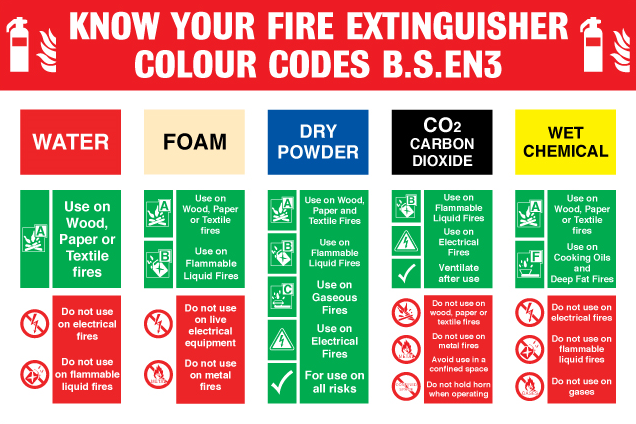
Water extinguishers are the most basic type and are primarily used for Class A fire risks. Water extinguishers are coloured signal red and are effective for fires caused by various organic materials including fabrics, textiles, coal, wood, cardboard, and paper.
When to Use: Office buildings, schools, residential properties, and areas with primarily combustible solid materials.
When NOT to Use: Never use on electrical fires, flammable liquids, gases, or cooking oil fires, as this can spread the fire or create electrical hazards.
Placement: Legislation states that occupants of a building should never be located further than 30 metres from the nearest extinguisher, and water extinguishers should be placed near exits on floors identified for Class A fire risk.
Foam Extinguishers (Cream Label)
Foam extinguishers are the most versatile option for many premises. Other extinguishers will be predominantly signal red with a label, band or circle covering at least 5% of the surface area of the extinguisher in a second colour – in this case, cream.
Multi-Purpose Capability: Being water-based, foam extinguishers can tackle both Class A fires (organic materials) and Class B fires (flammable liquids), making them ideal for mixed-risk environments.
Real-World Example: A garage forecourt would benefit from foam extinguishers as they can handle both paper/cardboard fires (Class A) and petrol spills (Class B).
Placement: Position by exits on floors identified as having Class A or Class B fire risks, typically in areas like warehouses, retail spaces, and mixed commercial environments.
Dry Powder Extinguishers (Blue Label)
Dry powder extinguishers offer the broadest fire-fighting capability of any single extinguisher type. The blue-labelled extinguishers can tackle Class A, B, C fires and electrical equipment up to 1000 volts.
Specialist Applications: Garage forecourts, welding and flame cutting businesses and buildings with large boiler rooms are examples of premises using flammable gases for chemical processes where this type of fire extinguisher is required.
Limitations: Should not be used on electrical equipment over 1000 volts or cooking oil fires. Additionally, the powder can damage sensitive electronic equipment, making them less suitable for server rooms.
Best For: Industrial environments, vehicle workshops, and areas where multiple fire risks are present.
Carbon Dioxide (CO2) Extinguishers (Black Label)
CO2 extinguishers are the go-to choice for electrical fire risks. CO2 extinguishers are mainly used for electrical fire risks and are usually the main fire extinguisher provided in computer server rooms.
How They Work: CO2 extinguishers suffocate fires by displacing the oxygen the fire needs to burn, making them perfect for sensitive electrical equipment as they leave no residue.
Placement Strategy: This would require a CO2 extinguisher to be placed close by, but not in the server room itself as it should be safe to access in the event of a fire.
UK Regulation: Any commercial building containing electrical equipment must contain a CO2 fire extinguisher that is a minimum of 2 kilograms in size. If there is equipment on site that is rated at 415 volts or more, then a 5kg CO2 fire extinguisher must be fitted to comply with regulations.
Wet Chemical Extinguishers (Yellow Label)
Wet chemical extinguishers are specifically designed for Class F fires involving cooking oils and fats. They’re essential in commercial kitchens and increasingly recommended for domestic use.
Kitchen Safety: The wet chemical creates a layer on top of burning oil, cooling it and preventing re-ignition. This makes them far more effective than water or foam on deep fat fryer fires.
Strategic Placement: A kitchen should have fire extinguishers positioned close by, but away from the cooking apparatus so that a member of staff can grab one without putting themselves in harm’s way.
Water Mist Extinguishers
A newer technology gaining popularity in the UK, water mist extinguishers use de-ionised water to create a fine mist that’s effective on multiple fire types.
Electrical Safety: BS EN3 allows a manufacturer, after successful completion of the test, to mark their product with the following words: ‘Suitable for use on Live Electrical Equipment up to 1000V at a distance of 1 metre’.
Domestic Recommendation: For a kitchen at home, a water mist extinguisher using de-ionised water and a fire blanket would be considered satisfactory for most situations.
UK Fire Extinguisher Regulations and Standards
Legal Framework
Fire extinguisher provision in the UK is governed by the Regulatory Reform (Fire Safety) Order 2005 (RRO), which places responsibility on the “responsible person” (usually the employer, owner, or occupier) to ensure adequate fire safety measures.
British Standards Compliance
All fire extinguishers sold in the UK must comply with BS EN 3, the European standard for portable fire extinguishers. BS EN3 requires that at least 95% of the body of the extinguisher MUST be coloured red, allowing only 5% colour coded zones on the extinguisher.
Colour Coding Standards
New extinguishers are manufactured to the standard BS EN 3.
Water extinguishers are coloured signal red.
Other extinguishers will be predominantly signal red with a label, band or circle covering at least 5% of the surface area of the extinguisher in a second colour indicating the contents of the extinguisher.
Important Note: The old fire extinguishers standard required the whole of the body of the extinguisher to be painted the appropriate colour. You will find these extinguishers in many premises and these are still legal, you do not need to change them unless the extinguisher is defective or at the end of its serviceable life and needs to be replaced.
Placement and Distance Requirements
Travel Distance Rules
UK regulations specify maximum travel distances to ensure extinguishers are accessible when needed:
- Class A and C fires: Extinguishers should be sited so that it is not necessary to travel more than 30 metres to reach one
- Class B and F fires: For Class B fires (those involving flammable liquids) and Class F fires (fires involving cooking oils and fats), the distance should be no more than 10 metres for someone to reach the right extinguisher
Strategic Positioning
Fire Safety Logic: This is usually by the doors or exit so that people are encouraged to move away from the danger rather than towards it.
Risk-Based Placement: Specialist extinguishers, such as dry powder for Class C fires in areas such as boiler rooms and wet chemical extinguishers for kitchens (Class F), should be positioned within easy reach of, but not too near, the specific fire hazard.
Mounting Requirements
Small extinguishers weighing up to 4 kg should be mounted with the carrying handle about 1.5m from the floor, whilst larger, heavier extinguishers should be mounted with their handles at about 1m.
Calculating How Many Extinguishers You Need
Basic Requirements
Generally, UK fire extinguisher regulations recommend that there should be two class-A fire extinguishers available on every storey of a building.
Size and Coverage
British Standard 5306 contains formulae for calculating the number of class A extinguishers. The calculation can be simplified by applying the rule of thumb that one 13A extinguisher covers 200 square metres of floor area.
Practical Calculation: To determine how many 13A extinguishers you need, divide your floor area by 200 and round up. For example, a 450m² office would need 3 extinguishers (450 ÷ 200 = 2.25, rounded up to 3).
Maintenance and Servicing Requirements
Legal Obligations
By law, all fire extinguishers must be serviced to BS5306 standards.
Fire extinguisher servicing must be carried out on an annual basis to comply with RRO regulations.
Monthly User Inspections
Monthly Visual Inspection: This can be carried out by the business owner or designated staff members and should check:
- The extinguisher is in its correct location
- The extinguisher hasn’t been discharged, tampered with, or damaged
- Pressure gauges show correct readings
- Safety seals and pins are intact
Professional Servicing
Extinguishers in commercial or public buildings should be visually inspected monthly for damage or pressure loss and should be serviced in line with the manufacturer’s instructions or to BS 5306-3.
Servicing Schedule:
- Water, foam, and powder extinguishers: have to be discharged and refilled every five years
- CO2 extinguishers: must be refurbished after ten years
Service-Free Options
One exception, however, are the kitemarked P50 servicing-free extinguishers which only need refurbishment after ten years and do not require maintenance within the ten years (other than the monthly visual inspection and a recorded yearly visual inspection by the owners).
Fire Blankets: An Essential Complement
Fire blankets serve as an important complement to fire extinguishers, particularly in kitchen environments. They’re ideal for:
- Small kitchen fires: Especially effective on chip pan fires and clothing fires
- Personal safety: Can be wrapped around a person whose clothing is on fire
- Immediate response: No training required and can be deployed instantly
Best Practice: For a kitchen at home, a water mist extinguisher using de-ionised water and a fire blanket would be considered satisfactory for most situations.
Real-World Application Examples
Office Buildings
- Primary need: Water or foam extinguishers for general combustibles (paper, furniture)
- Secondary need: CO2 extinguishers near electrical equipment and server areas
- Placement: Near fire exits and electrical distribution points
Restaurants and Commercial Kitchens
- Essential: Wet chemical extinguishers specifically rated for Class F fires
- Additional: CO2 extinguishers for electrical equipment
- Fire blankets: Near cooking areas for immediate response
Industrial Workshops
- Multi-hazard approach: Dry powder extinguishers for their versatility
- Specialist needs: Class D extinguishers if working with combustible metals
- Strategic placement: Near welding areas and fuel storage
Retail Premises
- General protection: Foam extinguishers for mixed Class A and B risks
- Electrical safety: CO2 extinguishers near tills and electronic equipment
- Customer areas: Water extinguishers in predominantly Class A risk areas
Professional Fire Risk Assessment
It’s crucial to consult with a fire safety professional to determine the exact requirements for your specific property, as we can provide tailored advice based on the latest regulations and your unique circumstances.
What a Professional Assessment Includes:
- Detailed fire risk evaluation
- Specific extinguisher type recommendations
- Optimal placement strategy
- Compliance verification
- Ongoing maintenance planning
Choosing a Reliable Service Provider
We recommend researching any fire safety service provider carefully before engaging their services.
Look for membership or accreditation with recognised trade bodies such as the Fire Industry Association (FIA), BAFE, the British Fire Consortium, or the UK Fire Association.
These organisations set industry standards and help ensure that companies operate professionally, ethically, and in full compliance with UK regulations.
Key Questions to Ask:
- Are they certified to BS 5306-3 standards?
- Do they provide detailed service records?
- What’s included in their annual service?
- Do they offer emergency call-out services?
- Can they provide references from similar businesses?
Common Mistakes to Avoid
Placement Errors
- Positioning extinguishers too close to the hazard they’re meant to protect against
- Blocking access routes with equipment or furniture
- Installing extinguishers at incorrect heights
Type Selection Mistakes
- Using water extinguishers in areas with electrical equipment
- Relying solely on one type of extinguisher in mixed-risk environments
- Choosing based on price rather than suitability
Maintenance Oversights
- Forgetting monthly visual inspections
- Delaying professional servicing
- Not replacing fire extinguishers after use (even partial use)
Fire Extinguishers Recycling and Responsible Disposal
Fire extinguishers cannot simply be thrown away when they reach the end of their life.
They contain pressurised chemicals and are classified as hazardous waste, requiring proper disposal and recycling procedures.
Why Proper Disposal of Fire Extinguishers Matters
Fire extinguishers are classified as hazardous waste and need to be disposed of carefully.
The pressurised nature and chemical contents present several risks:
- Environmental contamination: Chemicals can seep into soil and water systems
- Safety hazards: Pressurised containers can explode if mishandled
- Legal obligations: Improper disposal violates UK environmental regulations
Legal Requirements for Disposal
Under UK law, Fire extinguishers must be handled by recognised and licensed disposal entities to ensure safety during the disposal process. If you allow the removal of old fire extinguishers from your possession by person or company who does not hold a valid waste licence, you as the original extinguisher owner could be prosecuted for not using a licence holder.
Type-Specific Disposal Methods
Different extinguisher types require different disposal approaches:
Water Extinguishers: After ensuring the extinguisher is depressurised, the water can typically be drained into standard drainage systems. The remaining materials can be taken to recycling centres.
Dry Powder Extinguishers: The powder in these extinguishers is usually biodegradable, but it’s essential to ensure it doesn’t contaminate water sources. The powder should be contained and disposed of in sealed containers, ensuring it doesn’t spread.
CO2 Extinguishers: CO2 can be dispersed into the air during disposal, as it poses minimal environmental risk.
Foam Extinguishers: These require specialist disposal due to environmental concerns with AFFF (Aqueous Film Forming Foam). Foam extinguishers should never be drained into open water sources or land drains due to the risk of contamination.
Professional Recycling Services
Most components of fire extinguishers can be recycled effectively:
- Metal components: Steel and aluminium cylinders are highly recyclable
- Plastic parts: Many plastic components can be processed through standard recycling
- Chemical contents: Must be treated as hazardous waste through specialised facilities
Fire Protection Recycling and similar certified companies offer comprehensive recycling services, ensuring almost 100% of the fire extinguisher is recycled whilst guaranteeing that condemned extinguishers are removed from circulation.
Government Regulations
The UK Environment Agency has issued specific guidance through Regulatory Position Statement (RPS) 132, which requires businesses to:
- Empty all foams, water and powders from fire extinguishers into sealed containers before disposal
- Dispose of foam containing PFOS, PFOA, or PFHxS by high temperature incineration off site
- Keep detailed records for 3 years showing compliance
- Separate different types of powders and keep them dry
The AFFF Foam Crisis: Environmental Concerns and Phase-Out
One of the most significant developments in fire extinguisher technology has been the recognition of environmental and health hazards associated with AFFF (Aqueous Film Forming Foam) extinguishers.
What is AFFF and Why is it Problematic?
AFFF foam extinguishers contain harmful Perfluoroalkyl and Polyfluoroalkyl Substances (PFAS) chemicals. These substances, often called “forever chemicals,” do not break down naturally and accumulate in the environment and human body over time.
Health Risks: According to research, exposure to AFFF can lead to:
- Kidney and testicular cancers
- Thyroid disease
- Cardiovascular issues
- Endocrine disruption
- Potential increased susceptibility to infectious diseases
Rising Disposal Costs
The cost of AFFF foam extinguisher disposal is rising significantly. Earlier this year (March 2024) the price of disposing of AFFF foam fire extinguishers was roughly £2-£3 per unit. As more companies phase out AFFF foam, disposal services are becoming increasingly expensive and harder to secure.
Disposal Requirements
AFFF foam fire extinguisher disposal involves high-temperature incineration of the AFFF media. Businesses must utilise certified disposal services to safely eliminate their AFFF extinguishers, to protect the environment and ensure compliance with UK regulations.
Legal Framework: The HSE has held consultations on PFAS and is considering action that could result in another 40 PFAS substances being registered with UK REACH for regulations, including PFHxA (C6) used in newer AFFF foam extinguishers.
Alternatives to AFFF
Businesses are encouraged to switch to eco-friendly alternatives:
Fluorine-Free Foam (F3): Provides effective fire protection without PFAS chemicals Water Mist Extinguishers: Effective on multiple fire types including electrical equipment P50 Extinguishers: Sustainable choice with refillable design and 10-year service-free operation
Transition Strategy
Businesses can start replacing AFFF foam fire extinguishers that have reached the end of their usable life now, and gradually phase out remaining units over time. This approach helps manage costs whilst ensuring compliance and environmental responsibility.
Halon Fire Extinguishers: Banned but Not Forgotten
Halon fire extinguishers represent one of the most significant environmental restrictions in fire safety history.
The Rise and Fall of Halon
Halon 1211 (BCF) and Halon 1301 (BCM) were once considered the gold standard for protecting sensitive electronic equipment and valuable assets. These agents could extinguish fires without leaving residue and were safe for use around people in normal concentrations.
Why Halon was Banned
The EU ban on the use of Halon in fire extinguishers came into force in October 2000 and was implemented in the UK in 2003, as a result of scientific research linking Halon and other CFCs to ozone depletion. The ban followed the 1987 Montreal Protocol, which identified halon as an ozone-depleting substance with severe environmental impacts.
Environmental Impact:
- Halon has an extremely high ozone depletion potential
- Long atmospheric lifetime (up to 65 years)
- Contributes significantly to global warming
- Releases reactive bromine that damages the ozone layer
Current Legal Status
General Ban: It is illegal to own, use, or sell Halon fire extinguishers for general applications
Limited Exceptions: The ban includes exemptions for certain “Critical Uses”:
- Aircraft industry applications
- Military and armed forces use
- Specific petrochemical industry applications
- Certain marine applications
- Channel Tunnel installations
Identifying Halon Extinguishers
Fire extinguishers colour-coded green are vapourising liquids (Halons) and have been illegal, with some exceptions like aircraft and the military, since the end of 2003. Halon extinguishers may also appear in:
- British Racing Green (most common)
- Dark bottle green (military)
- Yellow or gold variants
- Red with green colour flash (newer identification)
Safe Disposal of Halon Extinguishers
It is strictly illegal to just dump Halon fire extinguishers or to discharge them into the atmosphere. Disposal must be through:
- Local authority recycling centres
- Licensed waste carriers
- Certified halon recovery services
- Fire safety companies with proper disposal credentials
Important: If you come across a Halon fire extinguisher, that is hazardous waste, it’s imperative to take it to a local authority recycling centre or arrange for its disposal through a licensed waste carrier.
Halon Alternatives
Modern replacements for Halon include:
CO2 Extinguishers: Provide similar protection for sensitive electronics without environmental impact Clean Agent Systems: HFC-227ea, FK-5-1-12, and inert gas blends for fixed systems Water Mist Systems: Advanced technology offering broad fire-fighting capability
Recycling and Halon Banking
Existing Halon stocks are managed through “halon banking” systems where recovered Halon is recycled for approved critical uses. This ensures that existing supplies are used efficiently whilst preventing environmental release.
Environmental Considerations and Temperature Sensitivity
The contents and/or operation of extinguishers is affected by temperature, and extinguishers conforming to BS EN 3 are marked with their operating temperature range. Extinguishers should not be exposed to temperatures outside this range.
Cold Storage Solutions: It is possible to obtain water and foam extinguishers containing anti-freeze for external areas.
Fire Extinguishers Training and Competency
Having the right extinguishers is only half the battle – your staff need to know how to use them safely and effectively. Consider:
- Basic fire safety training for all staff
- Hands-on extinguisher training for key personnel
- Regular fire drills to maintain competency
- Clear instruction signage on each extinguisher
Future Developments
The fire extinguisher industry continues to evolve with new technologies like:
- Improved water mist systems offering broader application
- Enhanced foam formulations with better environmental profiles
- Smart monitoring systems for remote maintenance tracking
- Advanced dry powder formulations with reduced cleanup requirements
Conclusion
Fire extinguishers are a legal requirement and a vital part of any comprehensive fire safety strategy.
Understanding the different types, their applications, and the regulatory requirements ensures you can make informed decisions about fire safety in your premises.
Remember that Fire can spread through a building in less than 30 seconds, making proper extinguisher selection, placement, and maintenance absolutely critical.
When in doubt, consult with certified fire safety professionals who can assess your specific risks and ensure full compliance with UK regulations.
Key Takeaway: There’s no single fire extinguisher that can handle all types of fires. Success lies in understanding your specific risks, choosing the right combination of extinguisher types, and ensuring they’re properly maintained and accessible when needed.
Useful Resources: